
Sofas
Sofa vs Couch vs Chesterfield: What Canadians Call It, and Why
By Sofa Studio Design Team · · 7 min read
Sofa vs couch is one of those debates that can split a dinner table. Some people insist a sofa is the fancier one; others say a couch is simply the one you nap on. Then a Canadian grandparent asks you to get your feet off the chesterfield, and the whole conversation starts again.
Here is the friendly version of the answer: where each word comes from, what Canadians actually say, how settees, loveseats, divans and sectionals fit in, and why none of it changes how you should choose the one in your living room.
Is there a difference between a sofa and a couch?
In everyday modern English, no. Sofa and couch both mean a long upholstered seat with a back, and usually arms, built for two or more people. Furniture makers tend to say "sofa" because it sounds a little more formal, while "couch" is the relaxed word most people use at home.
Historically, though, the two words pointed at slightly different pieces of furniture, and that is where things get interesting.
Sofa vs couch: where the words come from
Sofa
"Sofa" reached English in the 17th century by way of Turkish and French, from the Arabic suffa, a raised platform or bench spread with cushions and carpets. The original idea was a seat for sitting upright and socializing, which may be why "sofa" still sounds a touch more formal.
Couch
"Couch" is the older word in English, borrowed from the French coucher, "to lie down". A couch was first something to recline on, and in older furniture language it could mean a daybed-style piece with one raised end. Lounging is built into the name.
Settee
"Settee" is thought to come from "settle", the high-backed wooden bench that once stood by the fire in farmhouses and inns. Today a settee usually means a smaller, lighter, more upright seat for two or three, often on exposed legs.
Divan
"Divan" travelled from Persian into Turkish, where it named a council of state and, by extension, the long cushioned bench that lined the walls of the council chamber. In furniture it now means a low sofa, often without a back or arms, set against a wall. In Britain a divan is also a type of bed base.
Chesterfield
Strictly speaking, a chesterfield is a specific style: a deeply button-tufted sofa, traditionally in leather, with rolled arms set at the same height as the back. The name is popularly linked to an 18th-century Earl of Chesterfield, although that story is told far more often than it is proven.
Why Canadians say chesterfield
This is where Canada stands apart. For much of the 20th century, many English-speaking Canadians used "chesterfield" for any sofa at all, tufted or not. It is often listed among classic Canadianisms, alongside words like toque and washroom.
Ask around today and you will mostly hear it from older Canadians, while younger people tend to say "couch". Researchers who study Canadian English have noted that generational shift. So if your parents call it the chesterfield and your kids call it the couch, you are watching a small piece of language history play out in your own living room.
Elsewhere, the vocabulary shifts again. In the United States "couch" is the everyday word, and "davenport" can still be heard in some regions. In Britain "sofa" and "settee" both survive, and mid-20th-century commentators even treated the choice between them as a marker of social class. In Australia, many people simply call it the lounge.
Sofa, couch, settee, loveseat and more at a glance
| Word | What it usually means today | Where you might see it |
|---|---|---|
| Sofa | A long upholstered seat for two or more, with a back and usually arms | Product pages and showrooms; the Amiri is a classic example |
| Couch | The same thing as a sofa, in more casual speech | Most Canadian living rooms |
| Chesterfield | Traditional Canadian word for any sofa; as a style, deep button tufting and rolled arms level with the back | Older relatives, classic libraries and studies |
| Settee | A smaller, more upright seat for two or three, often on exposed legs | Entryways, bedrooms, reading corners; Sofa Studio's Settee |
| Loveseat | A sofa sized for two people | Condos, dens and as a partner to a larger sofa |
| Divan | A low sofa, often backless or armless, set against a wall | Lounges and daybed-style seating |
| Sectional | A sofa built from two or more connected sections, such as an L or U shape | Family rooms; the Amiri L Shape |
| Sofa bed | A sofa with a fold-out mattress inside | Guest rooms and condos; the Amiri Queen Sofa Bed |
Settee or loveseat: the two-seater question
These two get mixed up more than any other pair. A loveseat is defined by size: it is a sofa scaled for two people. A settee is defined more by style: lighter in look, more upright, often with a lower back and visible legs, and sometimes long enough for three.
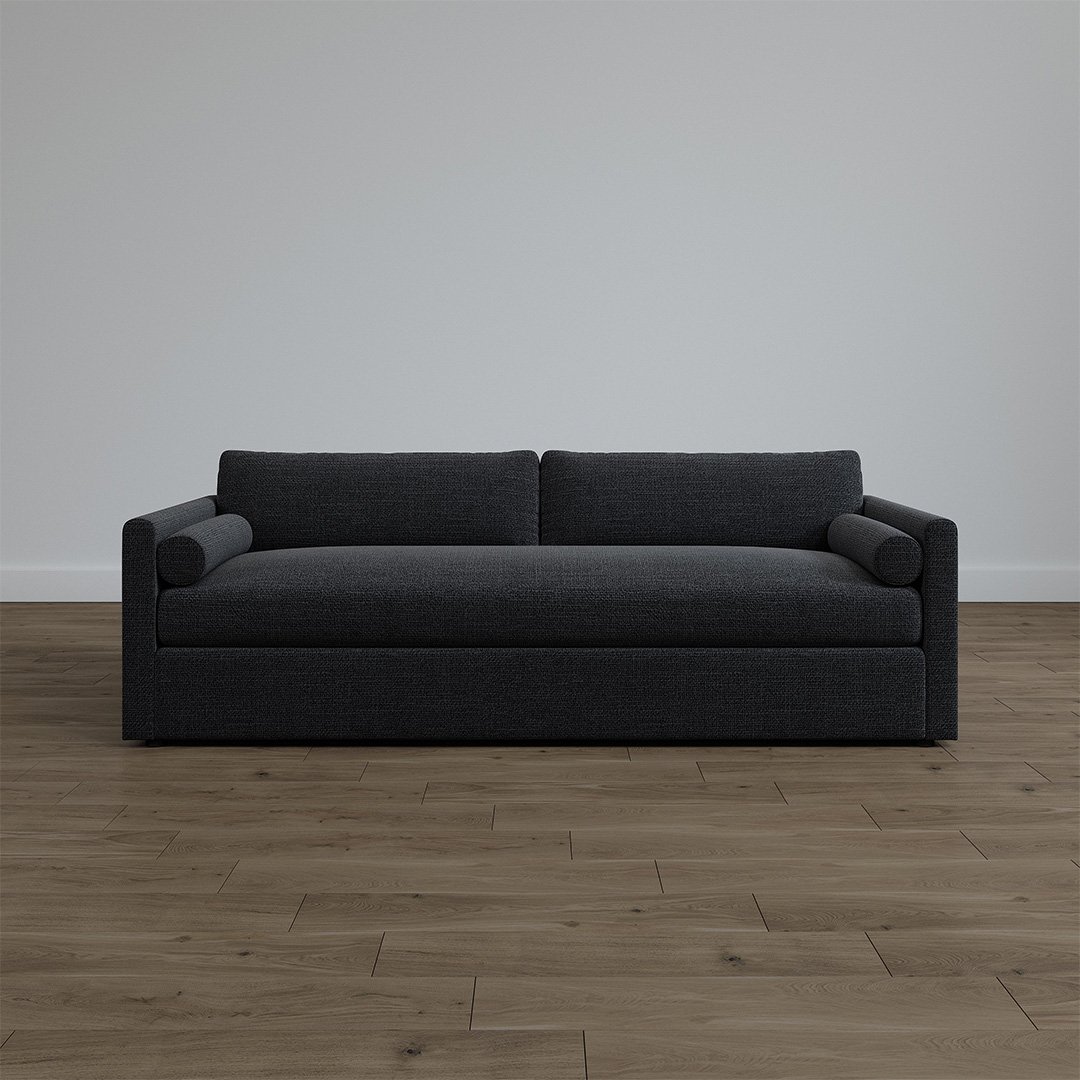
In practice many people use the words interchangeably, and that's fine. If you are shopping for a two-seater, focus on the tape measure rather than the label. On a custom sofa you set the width yourself. Amiri widths start at 60" (152 cm) and go up in 10-inch steps, so a 60" or 70" (178 cm) build gives you loveseat proportions with a full-size sofa's comfort. Sofa Studio also makes a design actually called the Settee, pictured with a single bench cushion and bolster pillows. For small rooms, our apartment and condo sofa guide covers sizing in detail.
A few more words from the living room
- Chaise longue. French for "long chair": a seat long enough to stretch your legs out. In North America it is often said as "chaise lounge", a twist so common that many dictionaries now list it. On a sectional, the chaise is the extended seat at one end. To see how the shapes compare, read sofa with chaise vs sectional.
- Ottoman. Named after the Ottoman Empire, where low cushioned seating was common. Today it means a padded footstool or low seat, and Sofa Studio offers optional ottomans in several sizes.
- Daybed. A seat about the size of a single bed, with a back and sides, built for both lounging and sleeping.
- Davenport. A mostly American term that is fading, usually traced to a 19th-century Massachusetts furniture maker. In Britain the same word can mean a small writing desk.
What actually matters when you buy one
Whatever you call it, the name tells you nothing about how well it is made or how it will feel. These things do:
- The frame. Look for kiln-dried hardwood. Sofa Studio builds on kiln-dried hardwood, adds plywood for reinforcement and blocks the corners for extra stability.
- The suspension. What sits under the seat decides how it feels over the years. Sofa Studio uses high-tenacity webbing with spring suspension.
- The cushions. Foam, fill and firmness shape comfort and how well the seat holds up. Our foam vs feather cushion guide explains the options.
- The size. Measure the room and every doorway on the way in. See how to measure for a sofa and our sofa dimensions guide.
- The fabric. Choose for your household, not just the photo. Our velvet vs bouclé vs linen comparison is a good start.
For the complete checklist, read how to choose a sofa.
Next step: find the one you'll call yours
Couch, sofa or chesterfield, the right one is the one that fits your room and the way you live. Browse custom sofas and sectionals to compare shapes, all designed and handmade in Sofa Studio's own workshop in Brampton, Ontario. If you would like to know more about what that means, read why buy Canadian-made sofas.
When you have a shortlist, a free design consult can help you settle the size and style. There is free delivery on orders over $1,999, and you can read how delivery works on the delivery information page.
Frequently asked questions
Is it couch or sofa in Canada?
Both are correct and mean the same thing. In conversation many Canadians say couch, while sofa is the usual word on product pages and in stores. Chesterfield is the traditional Canadian word, now heard mostly from older generations.
What is the difference between a chesterfield and a sofa?
In traditional Canadian usage there is no difference: chesterfield simply meant sofa. As a furniture style, though, a chesterfield is a specific design with deep button tufting and rolled arms that sit level with the back, traditionally in leather.
Is a loveseat the same as a settee?
Not quite. A loveseat is a sofa sized for two, so it is defined by its size. A settee is defined more by its style: lighter, more upright and often on exposed legs, sometimes seating three. Many people use the two words interchangeably.
Is a sectional a type of sofa?
Yes. A sectional is a sofa built from two or more sections joined together, usually in an L or U shape. It seats more people and can define a space in an open-plan room, but it needs more floor area than a straight sofa.
Where does the word sofa come from?
Sofa came into English in the 17th century through Turkish and French, from an Arabic word for a raised bench or platform spread with cushions. Couch is older in English and comes from the French verb coucher, to lie down.