
Sofas
Sofa Dimensions and Seat Depth: How to Find Your Fit
By Sofa Studio Design Team · · 8 min read
Sofa dimensions look simple on a spec sheet, but the numbers that matter most for comfort are the ones people tend to skip. Width tells you whether a sofa fits the wall. Seat depth, seat height and back height tell you whether you will actually enjoy sitting on it every evening.
This guide gives typical sizes in inches and centimetres, explains the difference between overall depth and seat depth, and shows how to match a sofa to the height of the people in your home. If you are still deciding what type of sofa you want, start with our checklist for choosing a sofa and come back here when you are ready to size it.
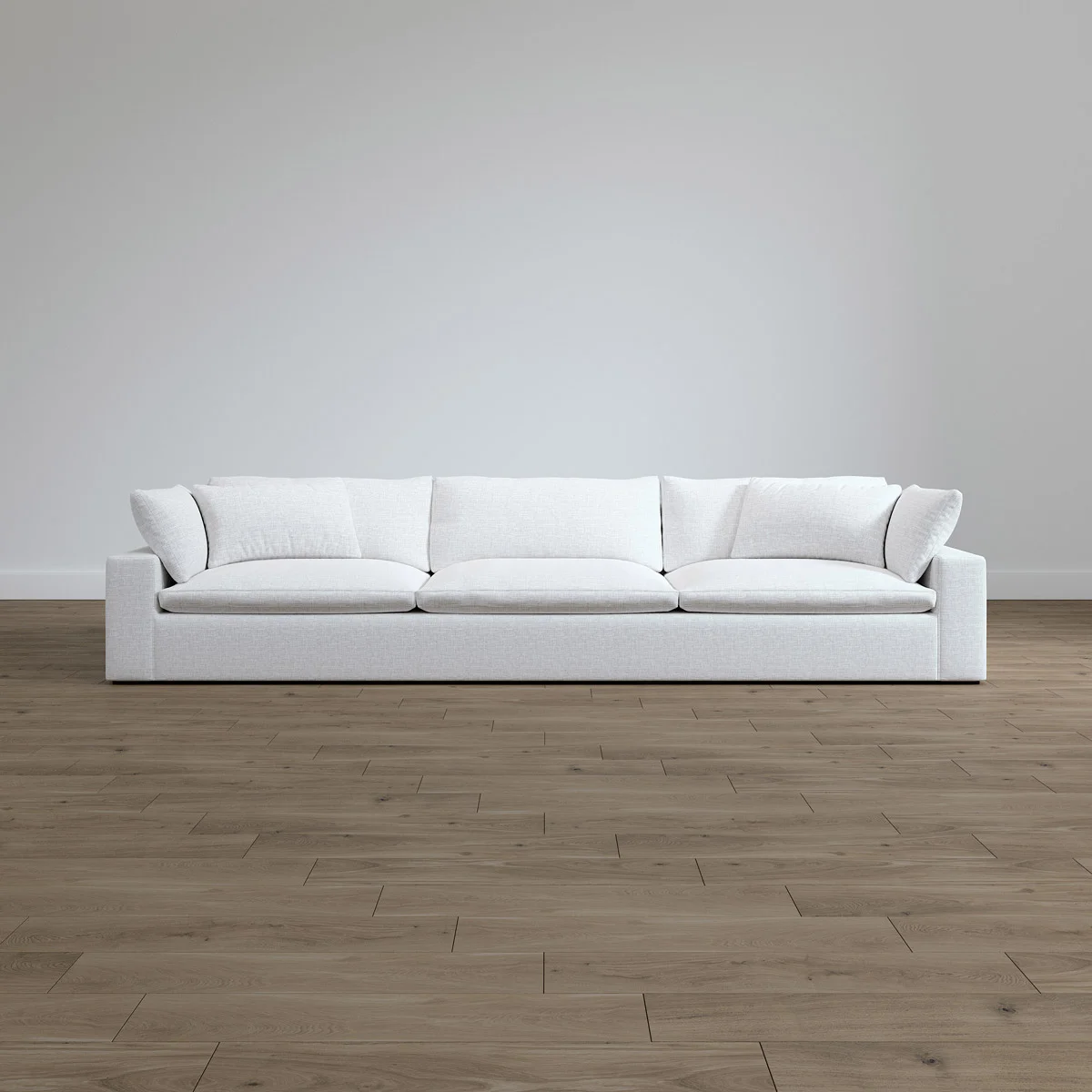
Standard sofa dimensions at a glance
Most three-seat sofas are about 72-90" (183-229 cm) wide, 32-40" (81-102 cm) deep overall and 30-36" (76-91 cm) tall at the back. The seat itself is usually 20-24" (51-61 cm) deep and 17-19" (43-48 cm) off the floor. These are general industry ranges, so individual models, and custom ones in particular, can fall outside them.
| Type | Typical width | Seats | Works well for |
|---|---|---|---|
| Loveseat | 52-72" (132-183 cm) | 2 | Dens, small rooms, or a second piece facing a sofa |
| Apartment-size sofa | 68-80" (173-203 cm) | 2-3 | Condos and narrow living rooms |
| Standard three-seater | 80-90" (203-229 cm) | 3 | Most family living rooms |
| Large sofa | 90-100" (229-254 cm) | 3-4 | Open-plan spaces and long walls |
| Extra-long sofa | 100" (254 cm) and up | 4 or more | Big rooms where a sectional would block the flow |
Treat the seat counts loosely. Arm style changes a lot: wide, square arms use noticeably more of the overall width than slim ones, which is why two sofas with the same overall width can seat people quite differently.
How to read sofa measurements
Spec sheets use a handful of terms, and mixing them up is the most common sizing error. Here is what each one means:
- Width: the outside of one arm to the outside of the other. This is the number to compare with your wall.
- Overall depth: the front of the seat to the back of the frame. It decides how far the sofa projects into the room.
- Height: the floor to the top of the back, including back cushions if they sit above the frame.
- Seat depth: the front edge of the seat to the face of the back cushion. This is the comfort number.
- Seat height: the floor to the top of the seat cushion before anyone sits on it. Cushions compress, so your sitting height will be a little lower.
- Arm height: worth checking if you like to lean on the arm or rest a laptop on it.
For getting a sofa through the door, overall depth and height matter more than width, along with the diagonal measurement explained in our older guide on measuring for a sofa.
Overall depth vs seat depth: why both matter
When Sofa Studio offers a depth choice, as on the Amiri, the three options are overall depths: Standard 36" (91 cm), Deep 40" (102 cm) and Extra-Deep 46" (117 cm). That is the sofa's full footprint from front to back, not the part you sit on.
The usable seat depth is always shorter, because the back frame and back cushions take up part of the overall measurement. How much shorter depends on the design: plump, loose back cushions take more room than a slim, tailored back. So when you compare two sofas, compare seat depth with seat depth and overall depth with overall depth. If a listing gives only one figure, ask which one it is. Our team can confirm the seat depth of a specific configuration before you order.
Depth also changes how a room feels. Moving from a 36" to a 46" overall depth brings the front of the sofa 10 inches (25 cm) closer to the coffee table, so you may need to move the table or choose a smaller one to keep a comfortable gap of roughly 14-18" (36-46 cm).
Which sofa seat depth suits your height?
The right seat depth lets you sit all the way back with your back supported, your feet flat on the floor and a small gap, about two to four fingers wide, between the seat edge and the back of your knees. Too shallow and your thighs hang off the front. Too deep and you either perch on the edge or slump into a pile of pillows.
| Height of the main sitters | Typical comfortable seat depth | A sensible overall depth to start from |
|---|---|---|
| Under 5'4" (163 cm) | About 19-21" (48-53 cm) | Standard 36", with a back pillow if needed |
| 5'4"-5'10" (163-178 cm) | About 21-23" (53-58 cm) | Standard 36" for upright sitting, Deep 40" for lounging |
| 5'10"-6'2" (178-188 cm) | About 22-25" (56-64 cm) | Deep 40" |
| Over 6'2" (188 cm), or anyone who naps or sits cross-legged on the sofa | 25" (64 cm) and up | Deep 40" or Extra-Deep 46" |
These ranges are general guidance, not rules. Leg length matters more than overall height, and habits matter as much as size: someone who curls up with their feet tucked under them will enjoy a deeper seat than their height alone suggests.
Mixed-height households
If one person is 5'2" and another is 6'3", size for the taller person and give the shorter one a firm back pillow. It is far easier to make a deep seat shallower with cushions than to make a shallow seat deeper. A sofa with a chaise is another answer, because the chaise gives the tall person somewhere to stretch out. Firmness plays a part too: a Medium or Hard seat sinks less than a Soft one, which can feel more supportive on a deep sofa and makes it easier to stand up.
Seat height, back height and arms
Seat height is easy to overlook until you sit on a very low lounge sofa. A seat around 17-19" (43-48 cm) suits most adults. Lower seats feel relaxed and modern but are harder to get up from, which is worth thinking about if older family members visit often. Soft cushions also sink further, so a soft seat on a low frame can feel lower than its listed height.
Back height decides whether your head is supported. Many contemporary sofas have backs that stop around shoulder height, which is fine for sitting upright and talking. If you like to lean your head back during a long film, look at a high-back design such as the Modena High Back Sofa or the York High Back Slipcover Sofa.
Arms come in many shapes. Wide, flat arms double as a perch for a mug; low, sloped arms are comfortable to lie against with a pillow. Whatever the style, remember that arm width comes out of the overall width, not on top of it.
Choosing a width: the per-person rule
For comfortable everyday sitting, allow roughly 24-30" (61-76 cm) of seat width per adult, then add the width of both arms. For three adults with room to shift around, that usually means an overall width of 84" (213 cm) or more.
A custom width takes most of the guesswork away. The Amiri, for example, can be ordered in 10-inch steps from 60" (152 cm) to 160" (406 cm), which makes it possible to fit an alcove, the space between two windows or a long wall in an open-plan room. Here is a simple way to land on a number:
- Measure the wall or zone the sofa will occupy.
- Subtract space for side tables, lamps or a walkway at either end. Many designers aim for a sofa about two-thirds the length of the wall.
- Round down to the nearest width on offer.
- Check the result against your delivery path, adding an extra 1-2 inches of clearance at every doorway, hallway, stairwell and elevator.
Thinking bigger than a sofa? Our comparison of L-shaped and U-shaped sectionals covers typical sectional dimensions, and the apartment-size sofa guide deals with compact sizes for condos.
Test your numbers on a sofa you already know
The most reliable way to choose a size is to measure a sofa you already find comfortable, whether it is your own, a friend's or one you sat on and liked.
- Sit all the way back. Note whether your feet rest flat and how much space there is behind your knees.
- Measure the seat depth from the front edge of the seat to the face of the back cushion.
- Measure the seat height from the floor to the top of the seat cushion.
- Measure the overall depth and width, and note the arm style.
- Write down what you would change: a little deeper, a little firmer, a taller back.
Keep those notes. A list of real measurements and the changes you want is the best brief you can give anyone building a sofa for you.
Put your measurements to work
Once you know your width and depth, browse our sofas with those numbers in hand, or look at a generous model such as the Cloud Sofa Grande if you have the space. If you are torn between two depths, book a free 30-minute virtual design consultation and bring your notes and a photo of the room; our team can turn them into a width, depth and firmness. It also helps to settle size and fabric together, so consider ordering swatches at the same time.
Frequently asked questions
What is the standard depth of a sofa?
Most sofas are about 32-40 inches (81-102 cm) deep overall, with a seat depth of roughly 20-24 inches (51-61 cm). Deep-seat sofas go further. On customizable models such as the Amiri, Sofa Studio offers overall depths of 36, 40 or 46 inches.
Is a 40-inch-deep sofa too deep?
Not for most people. An overall depth of 40 inches (102 cm) suits average to tall adults who like to lounge. Shorter sitters may want a firm back pillow, and you should check that the extra depth still leaves a comfortable gap to your coffee table.
What seat depth is best for tall people?
People over about 6 feet usually find seats of 22-25 inches (56-64 cm) or more comfortable, because their thighs are fully supported. Compare seat depth rather than overall depth, and consider a high back if head support matters to you.
How wide is a three-seater sofa?
Usually about 80-90 inches (203-229 cm), though it varies with the arm style. Allow roughly 24-30 inches of seat width per adult and add both arms to get a realistic overall width.
What seat height is easiest for older adults?
A seat height of around 17-19 inches (43-48 cm) with a Medium or Hard cushion is generally easier to get in and out of than a low, soft lounge seat. Sturdy arms to push against also help.