
Sectional sofas
Sofa with Chaise vs Sectional: Chaise, L-Shape, Dual and Corner Chaise Explained
By Sofa Studio Design Team · · 7 min read
The sofa with chaise vs sectional question trips up a lot of shoppers, partly because the terms overlap. A sofa with a chaise is technically a small sectional, and words like "corner chaise" and "bi-chaise" are used in slightly different ways from one maker to the next. What matters is how each layout sits in your room, how many people it seats properly and which way it faces.
This guide breaks down the four layouts you will see most often, compares them side by side, and walks you through left-arm and right-arm facing so the chaise ends up where you want it.
The difference in a nutshell
A sofa with chaise is a straight sofa with one extended seat for putting your feet up. It fits along a single wall and suits one lounger plus two or three people sitting. An L-shaped sectional adds a full second run of seats around a corner, so it seats more people upright but needs a corner and more floor space.
Between those two sit the variations: a dual chaise gives two people room to stretch out, and a corner chaise lets you lounge while still leaning back into the corner.
The four layouts in plain terms
Sofa with chaise
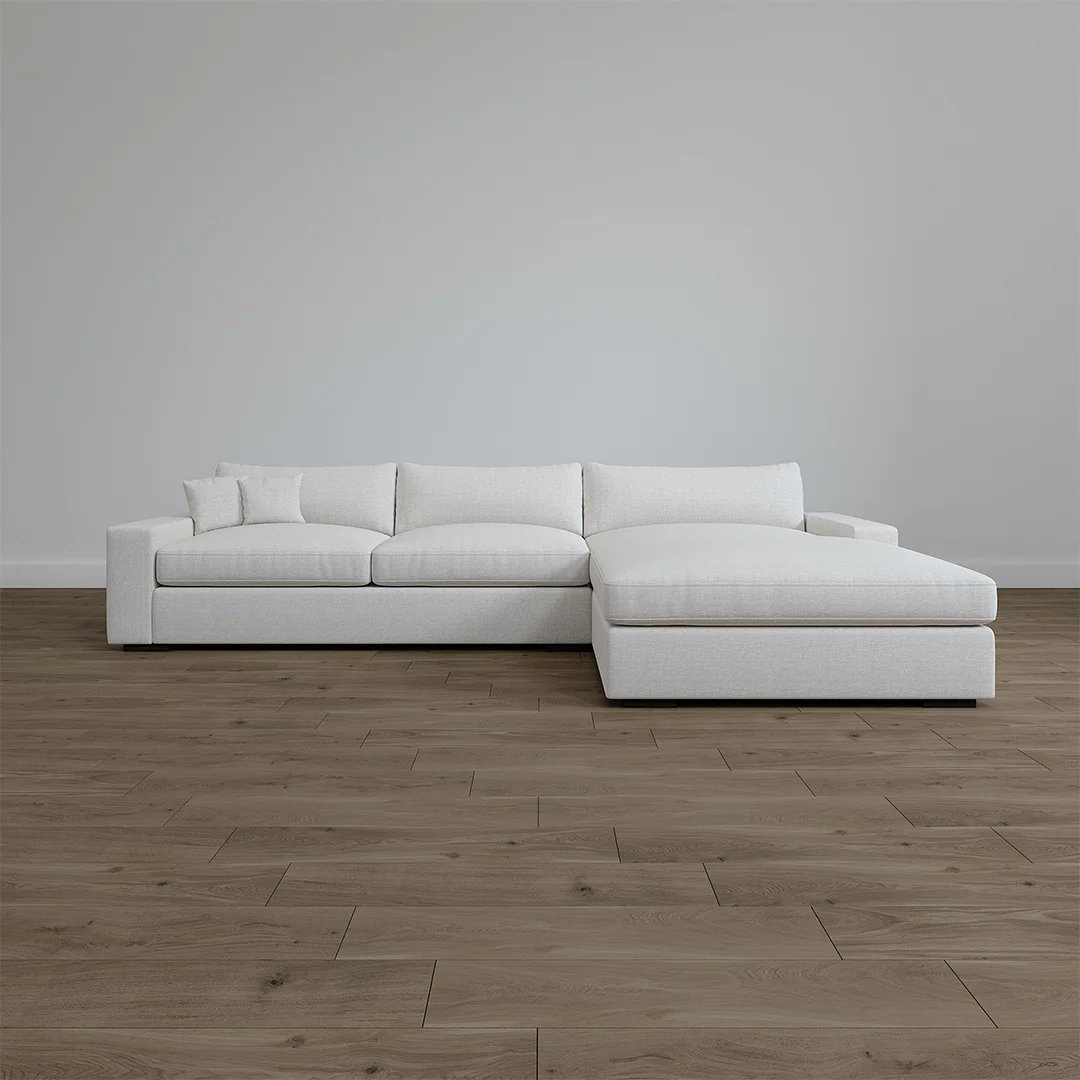
One end of the sofa extends forward into a long seat, typically around 60-70" (152-178 cm) from back to front, and the rest is a normal sofa. Because the chaise sits within the sofa's overall width, the footprint is a rectangle with one deeper end, which is why this layout works so well in condos and one-wall living rooms. Examples include the Amiri Chaise pictured above and the Amiri One Seat Plus Chaise.
L-shaped sectional
Two runs of upright seats meet at a corner seat. Everyone gets a back cushion, which makes an L the most sociable choice for families and for rooms where people sit more than they lounge. It needs a corner, or enough space to float in the room. See the Amiri L Shape.
Dual chaise (bi-chaise)
A chaise at each end of a sofa creates a U-like footprint that stays open in the middle. It is built for two people who both like to stretch out, often facing a TV. The Amiri Both Side Chaise is one example.
Corner chaise
Here the chaise takes the corner position, so you can lean back into the corner and stretch your legs out at the same time. On the Amiri with Corner Chaise, for example, the back cushions carry on around the corner and along the chaise, and the far end is open rather than finished with an arm.
Sofa with chaise vs sectional: side by side
| Layout | Typical footprint | Upright seats | Room to lounge | Best for | Watch out for |
|---|---|---|---|---|---|
| Sofa with chaise | 84-110" wide, 60-70" deep at the chaise (213-279 × 152-178 cm) | 2-3 | 1 person | Condos, one-wall rooms, solo loungers | A chaise on the wrong side can block a doorway or path |
| L-shaped sectional | 100-120" × 80-100" (254-305 × 203-254 cm) | 4-6 | Corner seat only | Families, rooms with a usable corner | Needs clearance along two sides |
| Dual chaise | 110-135" wide, 60-70" deep at both ends (279-343 × 152-178 cm) | 2-4 | 2 people | Couples, TV rooms | Middle seats are harder to get in and out of |
| Corner chaise | 100-120" wide, 60-75" deep at the chaise (254-305 × 152-191 cm) | 2-4 | 1 person, with back support | Lounging in the corner while others sit | Open end, and fewer upright seats than a full L |
The footprints are typical ranges across the industry, not the specifications of a particular model, so always check the measurements of the piece you are considering.
Left-arm facing vs right-arm facing, explained
Left-arm facing (LAF) and right-arm facing (RAF) describe which side an arm or chaise is on when you stand in front of the sofa and look at it, not when you are sitting on it. If you face the sofa and the chaise is on your right, it is a right-arm facing chaise. The Amiri Chaise in the photo at the top of this page has its chaise on the right as you look at it, so it is right-arm facing.
To get it right the first time:
- Stand in the middle of the room, facing the wall the sofa will go against.
- Decide which end the chaise or return should be on, as you look at it.
- Chaise on your right means right-arm facing (RAF). Chaise on your left means left-arm facing (LAF).
- Now picture yourself sitting down: from the seat, an RAF chaise is on your left. This flip causes most mix-ups.
- Check that the chaise will not block a doorway, balcony door or main walkway, and that it points somewhere pleasant, such as a window or fireplace.
- Before ordering, confirm the orientation against the product photos, and ask our team on live chat (11am-7pm Eastern) if anything is unclear.
One more wrinkle: on a sectional made of separate pieces, each piece is named for its own arm. A sofa with the chaise on the right, for example, is usually made of a left-arm facing sofa piece joined to a right-arm facing chaise.
Matching the layout to your room
- Narrow condo living room: a sofa with chaise, with the long end pointing away from the entry and the balcony door. Our condo sofa guide has small-space sizes.
- Room with a corner and a doorway on the opposite side: an L-shape tucked into the corner, so its open ends face the traffic.
- Family room where two people both claim the chaise: a dual chaise, or an L with a separate ottoman.
- Open-plan space where the sofa floats: a sofa with chaise or a dual chaise, both of which read as one clean shape from behind, provided the back is upholstered to the same standard as the front.
- Someone who naps on the sofa: a corner chaise, or a chaise long enough for their height. Taller people should look at the longer end of the typical 60-70" range.
Choosing between larger L and U shapes? Our L-shaped vs U-shaped sectional comparison covers room sizes in detail.
Comfort details that matter as much as the shape
Shape decides how you sit; construction decides how it feels. These are worth deciding at the same time. They are options on our sofas; for a sectional, check its product page to see which ones apply to that model.
- Depth. Overall depth comes in Standard 36", Deep 40" or Extra-Deep 46". Deeper seats suit loungers and taller people, while standard depth suits upright sitting. Our seat depth guide explains how to choose.
- Firmness. Soft, Medium or Hard. Softer seats feel cozy on a chaise but let you sink further; a firmer seat can feel more supportive for upright sitting.
- Cushion style. A no-stitch seat looks relaxed, while a stitched seat with a border keeps a crisper edge.
- Ottoman instead of a chaise. Optional ottomans come in several sizes. An ottoman is a footrest you can move, which can suit a room you rearrange better than a fixed chaise.
Next step: tape it, then compare
Tape the outline of your favourite layout on the floor, mark which end the chaise goes on, and stand where you will usually see it from. Then browse sofas with chaise and L-shaped sectionals knowing exactly which orientation you need. If you are torn between two layouts, book a free 30-minute virtual design consultation and our team can help you settle it.
Frequently asked questions
Is a sofa with a chaise considered a sectional?
Usually, yes. It has an L-like footprint and is often built in two pieces, so most makers group it with sectionals. The difference is that it has one extended lounging seat rather than a second run of upright seats.
Can I move the chaise to the other side later?
On most fixed designs, no. The chaise is built for one side and the orientation is chosen when you order, so check it carefully. Designs that use a loose ottoman as the footrest, and modular sectionals that can be rearranged, give you more freedom.
How long is a typical chaise?
Most chaises measure roughly 60-70 inches (152-178 cm) from back to front, though it varies with the model and the seat depth you choose. If you are tall and plan to stretch out, look toward the longer end of that range and check the exact measurement of the model.
What do LAF and RAF mean on a sectional?
LAF means left-arm facing and RAF means right-arm facing. They describe which side the arm or chaise is on when you stand facing the sofa, not when you are sitting on it. An RAF chaise is on your right as you look at the sofa, and on your left once you sit down.
Is a sofa with chaise or an L-shape better for a small living room?
A sofa with chaise is usually the better fit. It stays within one wall and adds lounging space without needing a corner or clearance along a second wall. An L-shape works in a small room only if there is a usable corner and the walkways stay open.