
Sofa buying guides
Foam vs Feather Sofa Cushions: Choosing the Right Fill and Firmness
By Sofa Studio Design Team · · 7 min read
The foam vs feather sofa cushions question decides how a sofa feels every time you sit down, and how much attention it needs to keep looking good. Foam brings shape and support. Feather brings that slow, sink-in softness. Most well-made sofas don't pick a side; they layer the two.
This guide explains what sits inside a cushion, how foam, poly fill and feather-down compare, why foam density and firmness are different things, and how to choose between Soft, Medium and Hard when you order a custom sofa from Sofa Studio.
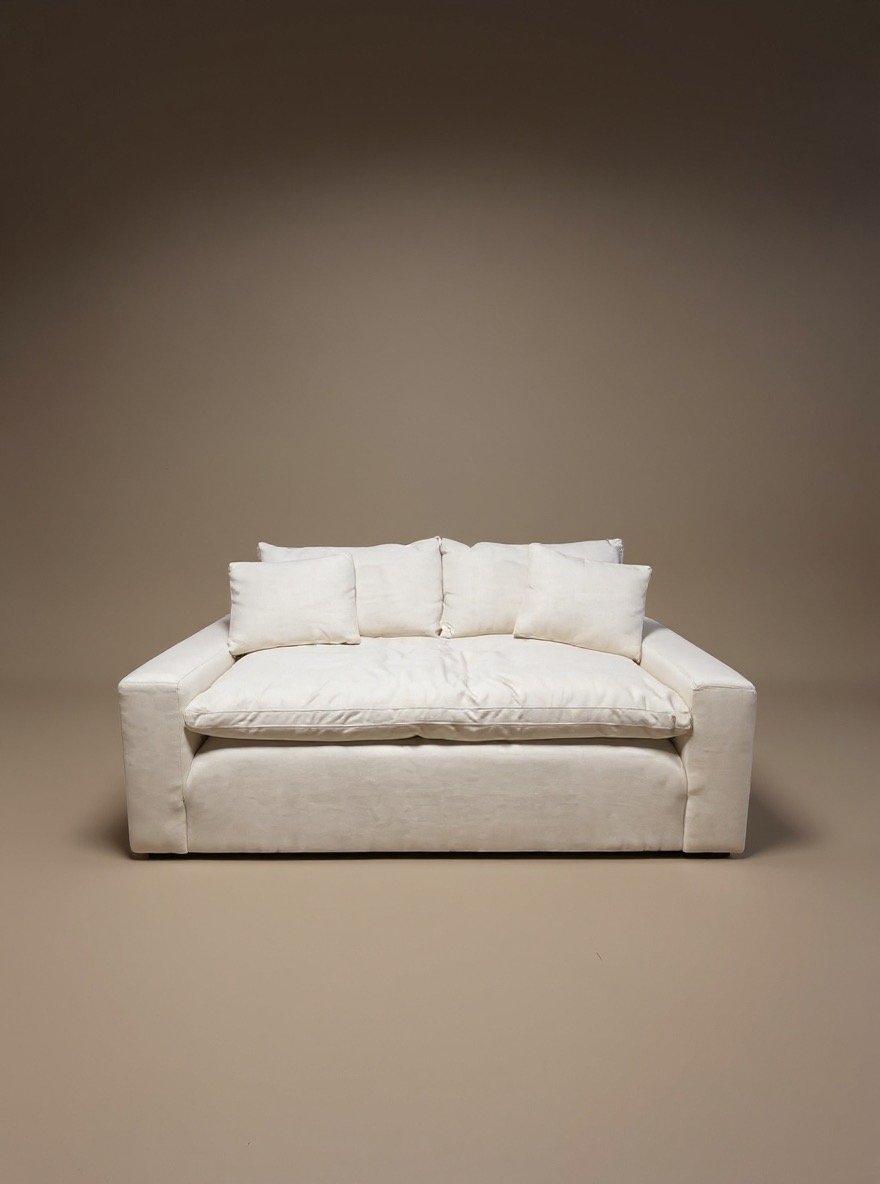
Foam or feather: what most people should choose
Choose foam-led cushions if you want a seat that holds its shape, looks tailored and needs little upkeep. Choose a feather-down or poly-fill blend if you want a softer, more relaxed sit and you don't mind fluffing cushions regularly. For most households the best answer is a combination: a foam core for support, wrapped in softer fill for comfort.
That combination is how Sofa Studio builds its seat cushions. Every seat cushion starts with a foam core inside a wrap of vegan poly fibre, and where a cushion has a loose fill on top, it is either Feather Down or Poly Fill.
What is inside a sofa cushion
A sofa cushion is usually built in layers, and each one does a different job:
- The core. A block of foam gives the cushion its structure and stops you sinking too far. Its density and firmness decide much of how the seat feels and how long it keeps its shape.
- The wrap. A layer of fibre around the foam softens the edges and gives the cushion a rounded, crowned look rather than a hard, boxy one.
- The loose fill. On softer styles, a layer of feather, down or poly fibre adds the sink-in feel and lets the cushion mould to you.
- The cover. The fabric and its sewing style shape how the fill reads visually, from crisp and tailored to soft and slouchy.
At Sofa Studio, the foam core is wrapped in vegan poly fibre. With Feather Down, the loose fill is a 9:1 ratio of feather to down: the feathers give body and the down adds softness. Poly Fill is made entirely of vegan poly fibre, designed to mimic the feel of feather, which makes it the option to choose if you would rather avoid animal products.
Foam vs feather sofa cushions compared
These are general characteristics of each approach. Remember that Sofa Studio's seat cushions always start with a foam core, so even the softest fill sits on a supportive base.
| Foam-led | Poly Fill blend | Feather Down blend | |
|---|---|---|---|
| Feel | Supportive; springs back quickly | Soft, sink-in feel made to mimic feather | The softest, most relaxed sink-in feel |
| Look | Crisp and tailored; holds its outline | Relaxed and slightly slouchy | Lived-in; creases where you sit |
| Upkeep | Minimal; rotate occasionally | Fluff regularly and rotate | Fluff regularly and rotate; plump after heavy use |
| Over time | Depends on foam density; higher density holds shape longer | Loose fill shifts and settles, so it needs plumping | Shifts and settles the most; plumping restores it |
| Animal products | No feather or down | Entirely vegan poly fibre fill | Contains feather and down |
| Often suits | Upright sitters, home offices, tidy-looking rooms | Softness without animal products | Loungers, nappers, relaxed family rooms |
If the relaxed, feathery look is what draws you, models such as the Cloud All Feather Sofa and the Aria Skirt Sofa with Feathers are named for it. As with every model, check the product page for its exact cushion and fill options.
Foam density is not the same as firmness
This is the most misunderstood part of cushion shopping. Density and firmness are two separate measurements, and a foam can be high in one and low in the other.
- Density is how much material is packed into a given space, measured in kilograms per cubic metre (kg/m³). As a general rule, the higher the density, the longer the foam keeps its shape. Foam of about 23 kg/m³ or more is generally classed as high density.
- Firmness is how much pressure it takes to compress the foam, which is what you actually feel when you sit. In the foam industry it is usually measured as an indentation force.
Two foams can share the same density and feel completely different, one soft and one firm. So a "high-density" label tells you about durability, not comfort, and it is worth asking about both when you compare sofas. Sofa Studio uses high-grade foams intended to resist sagging. For more on what makes a sofa last, from foam to frame, see how long a sofa should last.
Soft, Medium or Hard: choosing your firmness
Sofa Studio's custom sofas are offered in three firmness levels: Soft, Medium and Hard. Options can vary by model, so check the product page, but here is how to think about them.
| Firmness | How it feels | Often suits |
|---|---|---|
| Soft | You sink in and the cushion hugs you | Loungers, movie nights, people who sit with their feet tucked up |
| Medium | Some give, but you stay on top of the cushion | Households where people sit differently; a sensible default |
| Hard | Upright and supportive with little sink | Upright sitters, home offices, anyone who finds a low, soft seat hard to get out of |
- Think about how you sit for hours, not seconds. A very soft seat feels wonderful at first touch. Picture a two-hour film on a Sunday instead.
- Pair firmness with depth. Overall depth options are Standard 36" (91 cm), Deep 40" (102 cm) or Extra-Deep 46" (117 cm). A deep seat with Soft firmness makes a lounging sofa; a standard depth with Medium or Hard keeps you upright. Our sofa dimensions and seat depth guide helps match depth to your height.
- A firmer seat can feel more supportive if you like to sit upright, and it is generally easier to stand up from.
- When in doubt, choose Medium. Cushions soften a little as they break in, so a Medium seat tends to settle toward comfortable rather than too soft.
On a customizable model such as the Amiri, you choose firmness alongside width, depth, cushion style and fabric, so the whole seat can be tuned to how your household sits.
How cushion style changes the look of the fill
The way a cover is sewn affects how a fill looks day to day, so choose fill and style together.
Seat cushions
A stitched seat with a border has a boxed side panel that keeps the cushion's edges crisp and tailored. A no-stitch seat skips that sewn border detail for a simpler, softer edge that suits a relaxed look. A bench seat uses one long cushion across the whole sofa, as on the Cloud Bench Seat Sofa, which avoids gaps between cushions and gives an unbroken line.
Back cushions
Bordered back cushions have a side panel and look structured. Knife-edge back cushions are two panels sewn together at the edge, like a throw pillow, so they look softer and slouchier. A loose fill in a knife-edge back gives the most relaxed, lived-in look of all.
Living with your cushions: upkeep and expectations
- Fluff loose-fill cushions regularly. Feather Down and Poly Fill both shift as you sit. A quick plump when you tidy the room, plus a thorough fluff every week or so, keeps them full and even.
- Rotate cushions. Swap seat and back cushions between positions so the favourite seat doesn't wear faster than the rest.
- Expect some creasing with feather. That relaxed look is the point of a loose fill. If it bothers you, choose a bordered style and a firmer setting.
- The odd feather is normal. With feather fills, an occasional feather working its way through the fabric is part of the territory.
- Allow a break-in period. New cushions often feel a little firmer for the first few weeks before they settle.
- Keep the covers fresh. For care of the cushion covers themselves, see how to clean a fabric sofa.
Next step: talk it through before you order
Firmness is the hardest thing to judge from a screen. If you're unsure, Sofa Studio's designers run a free virtual consult of about 30 minutes on weekdays between 11am and 7pm Eastern. Describe how you like to sit, who uses the sofa most and how deep you would like it, and the team can help you match fill, firmness and depth.
Prefer to see pieces in person? The Brampton showroom is at 8032 Torbram Rd; phone 905-799-8877 before you set off, or book a consult first. You can also browse all custom sofas to compare cushion styles side by side.
Frequently asked questions
Do feather cushions go flat?
Feather and other loose fills settle and flatten between plumpings, which is normal. Regular fluffing restores the loft. Because Sofa Studio seat cushions have a foam core, the seat keeps its underlying support even when the loose fill has shifted.
Is Poly Fill as soft as feather?
Poly Fill is made entirely of vegan poly fibre designed to mimic feather, so it gives a similar soft, sink-in feel. It suits anyone who wants a relaxed cushion without animal products. Like feather, it needs regular fluffing to stay plump.
What foam density should I look for in a sofa?
As a general guide, foam of about 23 kg/m³ or more is classed as high density, and higher density usually means a cushion keeps its shape longer. Density doesn't tell you how firm a cushion feels, because firmness is a separate measure. Ask about both when comparing sofas.
Which firmness suits people who like to sit upright?
Medium or Hard. A firmer seat can feel more supportive and keeps you sitting up rather than sinking back, especially on a standard-depth sofa. Pair it with a depth that lets your feet rest flat on the floor.
Why do my cushions look different from each other after a few months?
Usually because one seat gets far more use than the others. Rotating and fluffing cushions regularly evens out wear, and starting from the first week is much easier than trying to correct uneven cushions later.