
Sectional sofas
Modular Sectional Guide for Canada: Pros, Cons and Planning Your Layout
By Sofa Studio Design Team · · 7 min read
A modular sectional is built from separate, self-contained pieces, such as armless seats, corners, chaises and arm-end seats, that connect to each other and can be rearranged. For Canadians who move between condos, townhouses and houses, or who simply like to change a room around, a modular sectional in Canada can be one of the most practical long-term buys. It does ask for more planning than a fixed sectional, especially if you think you might add to it later.
This guide explains what modular really means, where it shines, where it falls short, and how to plan a configuration that makes sense now and after your next move.
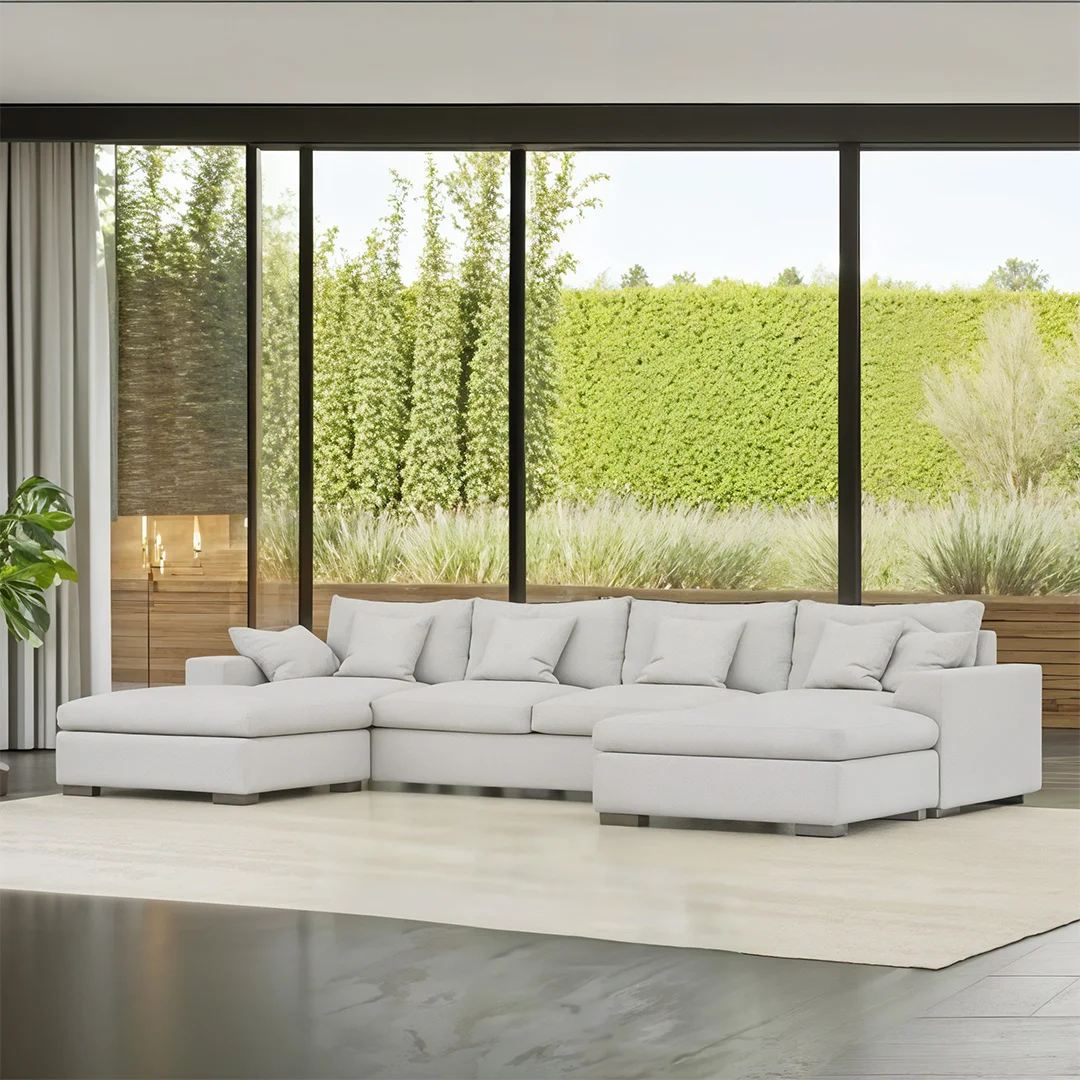
What makes a sectional modular?
A modular sectional is made of independent units that join together and can be rearranged, separated or added to. A standard sectional is also built in sections, but its pieces are designed to go together in one set layout, with the chaise or return on the side you chose when you ordered.
Most modular systems draw on some mix of these pieces:
- Arm-end seats with an arm on the left or right, which finish each end.
- Armless seats that sit in the middle and set the overall width.
- Corner units that turn a straight run into an L or a U.
- Chaises for stretching out.
- Ottomans that work as a footrest, an extra seat or a way to turn a seat into a lounger.
Not every system offers every piece, and names vary from maker to maker, so check what is available for the model you are considering.
Modular vs fixed sectional: the trade-offs
| Consideration | Modular sectional | Fixed sectional |
|---|---|---|
| Changing the layout | Rearrange into a new shape, or split into a sofa and a chair | One layout; the chaise or return stays on the side you ordered |
| Moving to a new home | Can be reconfigured to suit a different room | May not suit the next room's shape |
| Getting through doors and elevators | Each piece is usually smaller and lighter | Sections can be long, especially a full sofa section |
| Adding seats later | Possible, but it needs planning (see the note on add-on pieces below) | Generally not possible |
| Day-to-day feel | Pieces must be connected securely or they can creep apart | Fewer joins, so the sofa tends to stay put |
| Planning effort | More decisions about which pieces and in what order | Simpler: choose a shape, a size and a fabric |
The short version: modular buys you flexibility, and fixed buys you simplicity. Neither is automatically better built or more comfortable. Comfort comes from the frame, suspension, cushion fill, depth and firmness, which our guide to foam vs feather sofa cushions covers in detail.
Who a modular sectional suits, and who it does not
Modular tends to pay off if you:
- rent, or expect to move from a condo to a house in the next few years;
- live somewhere large items must fit into an elevator or up a narrow stairwell, such as a condo tower or an older semi with tight stairs;
- have an open-plan space you like to rearrange when you host;
- want a basement or family room sofa that can split into a sofa and a separate chair when guests stay over.
A fixed sectional is usually the better fit if you know exactly where the sofa will live for the long term, prefer fewer joins between pieces, or simply do not want to think about how the parts connect. If you are leaning that way, our L-shaped vs U-shaped sectional comparison will help you choose a shape.
How to plan a modular layout, step by step
- Measure the room you have now. Note wall lengths, doorways, windows, radiators and vents, then tape the outline of your first layout on the floor.
- List your must-haves. How many people sit at once? Does someone need a chaise? Will the sofa face a TV, a fireplace or the rest of the room?
- Sketch the next layout too. If a move is likely, draw the shape you would want in a bigger or smaller room and check that the same pieces can make it.
- Decide whether to buy everything now. If you are fairly sure you will want the larger layout, it is often simpler to order every piece at once and use the spare as a chair or ottoman until you need it.
- Check each piece against the delivery path. Modules are smaller than fixed sections, but each one still has to clear your tightest door, stair turn or elevator with 1-2 inches to spare. Our older post on measuring for a sofa explains the method.
- Confirm left and right. Arm-end seats and chaises are usually described as left-arm or right-arm facing, judged as you stand facing the sofa. Our sofa with chaise vs sectional guide shows how to get this right.
- Choose a fabric that will age gracefully. This matters more for modular than for fixed sofas, for the reasons below.
Common configurations to sketch with
| Layout | Typical pieces | Works well for |
|---|---|---|
| Straight sofa | Two arm-end seats with one or two armless seats between | Narrow living rooms, condo walls, dens |
| Sofa with chaise | An arm-end seat, one or more armless seats and a chaise | One-wall layouts where someone likes to stretch out |
| L-shape | Arm-end seats, armless seats and one corner | Rooms with a usable corner |
| Dual chaise | A chaise at each end with armless seats between | TV rooms and open-plan spaces where the sofa floats |
| U-shape | Two corners, armless seats and arm-end seats or chaises | Large family rooms and basements |
| Split set | A shorter sofa plus a separate chair or ottoman | Two smaller rooms, or the first year after a move |
The Harmonn Modular shown at the top of this page is set up as a dual-chaise layout, with a chaise at each end. If you like that look but do not need to rearrange it, fixed designs such as the Amiri Both Side Chaise and the Amiri L Shape offer similar shapes as set configurations.
Adding pieces later: read this first
At Sofa Studio, modular sectionals can be expanded or rearranged, but individual modular pieces are special orders and final sale. They sit outside our standard 30-day return window, so an extra seat or corner ordered on its own cannot be sent back if it turns out not to suit. The full terms are on our returns page.
Two practical things follow from that:
- Plan the full layout up front. Tape it out, measure the delivery path and, if you are unsure, talk it through with our team before you order.
- Expect fabric to change a little over time. Upholstery that has been used and exposed to light for a few years rarely looks identical to a brand-new piece in the same colour, and dye batches can vary slightly. Dark, saturated colours tend to fade fastest. Placing the sofa away from sunny windows and radiators helps. If you plan to add pieces later, a colourfast fabric is a sensible choice, such as our Thread-Dyed Cotton Linen, where the yarn is coloured before it is woven.
To ask about adding a piece to an existing sectional, email info@sofastudio.ca with the model, the colour and the piece you have in mind.
Plan it on paper, then with us
Sketch two layouts, the one you need now and the one you might want later, and bring both to a free 30-minute virtual design consultation. Our designers can help you work out which pieces cover both before anything is final.
Colour matters more than usual when pieces may be added later, so look at fabric swatches in your own light before you commit. You can choose up to five, and the cost is refunded when you complete a sofa order. For ideas, browse our recent custom projects or all sectional sofas.
Frequently asked questions
Can I add pieces to a modular sectional later?
Yes, that is the point of a modular design. Bear in mind that a single module bought later is a special order and final sale, so it cannot be returned; measure carefully first. To ask about a particular piece, email info@sofastudio.ca with your model and colour.
Is a modular sectional a good idea for a condo?
Often, yes. Individual modules are usually smaller than the sections of a fixed sofa, which helps in elevators and tight hallways. You still need to measure every doorway and the elevator, allowing an extra 1-2 inches.
Will a new module match my existing sectional?
It may not be an exact match. Fabric that has been in use and exposed to light changes slightly over time, and dye batches can vary. A colourfast fabric and keeping the sofa out of direct sun both reduce the difference.
Are modular sectionals less sturdy than fixed ones?
Not inherently. Sturdiness comes from the frame, joinery and suspension inside each piece. The main difference is that modules have to be connected securely, so ask how the pieces join and check that they stay aligned in daily use.
How is a modular sofa different from a regular sectional?
A regular sectional comes in sections that fit together in one fixed layout. A modular sofa is made of independent units you can rearrange, separate or add to, so the same pieces might be a straight sofa in one home and an L-shape in the next. Most modular designs are sold as sectionals, but not every sectional is modular.